Blake's 7 (1978)


Thanks to Chicken Dynasty (to whom I owe the excellent screencaps in this post), back in November 2025, I watched the first episode of Blake’s 7, a British dystopian science fiction show, that more than makes up for its modest budget with powerful and uncomfortably prescient storytelling. Set in the “third century of the second calendar,” the show imagines a future where Earth is under the control of the authoritarian Federation, which has drugged and propagandized creative and independent thought out of a population held captive in a windowless sphere cut off from the outside world. Read on for my spoilerific impressions of a show that’s been out longer than I’ve been alive.
** ** **
Episode 1, The Way Back, introduces Roj Blake (Gareth Thomas)—a man so bland, I could not pick him out of a police line-up derived exclusively from bowls of mashed potatoes. If you asked me what this man looks like, I couldn’t tell you. He’s a composite of every non-descript British guy over fifty to ever grace the small screen, which is impressive because he was only thirty-three (33) years old in this episode. Thirty-three (33). That’s the same age as Zohran Mamdani. Go ahead. Tell me this isn’t one of the most fifty-year-old looking thirty-somethings you’ve seen.
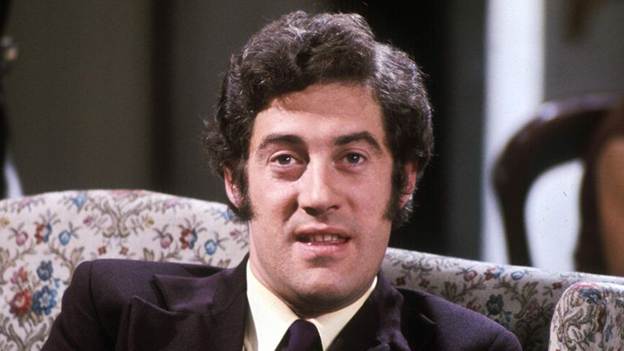
Anyway, Roj’s ordinariness is crucial to the narrative, since he’s introduced to the audience as a regular schmegular citizen of the Federation looking for information about his mother and sister, who, as far as he knows, have emigrated to a frontier world. In pursuit of that information, he ditches the suppressant-laced food that keeps everyone zombified and covertly meets Ravella and Richie, who claim to have the intel. They lead him outside the city, which we learn is a Category Four crime, to a meeting of a resistance group led by Bran Foster, which is presumably a worse crime.
Foster informs Blake that he, Blake, was a prominent resistance leader, but was captured and brainwashed by the Federation after he was betrayed by a member of the resistance. The government not only erased his memories of the rebellion, they also executed his entire family. The communications he’s been receiving from his family are deepfakes designed to keep him tractable. ::whereupon Hype looks directly into the camera::
Before Blake can process this, the most suspicious motherfucker I’ve ever seen identifies himself as a security officer to the gathered participants and makes like he’s their guy on the inside.
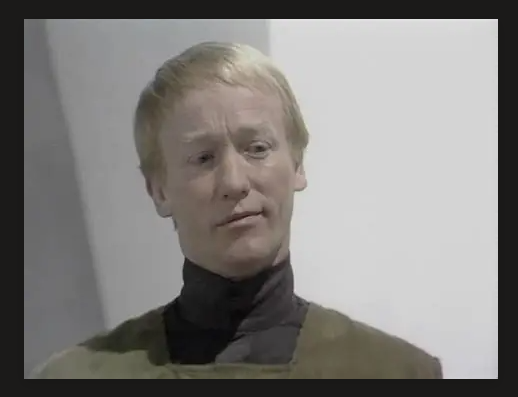
The name’s, Tarrant, Dev Tarrant (Jeremy Wilkin), and he’s what one of those white-blonde Children of the Damned would look like if they reached adulthood. Blake disappears down a beautifully drab corridor to freak the fuck out and have some flashbacks. Not five seconds later, Federation shock troops bust in and gun down the unarmed resistance. The absented Blake survives, only to be arrested when he tries to sneak back into the city.
In prison, Blake is interrogated by the Federation’s mentalist, Doctor Havant, who gaslights Blake, insisting that the massacre was imagined. In the meantime, Arbiter General Ven Glynd and prosecutor Alta Morag, who fear Blake’s notoriety could inspire further resistance, decide to use this opportunity to discredit Blake, rather than execute him and make him a martyr. They decide to implant false memories and charge him with crimes he did not commit to fracture any remaining solidarity among the dissidents.
Those crimes? Pedophilia.
Gentle reader, I watched this episode a week after the Andrew formerly known as Prince was stripped of his titles following the release of some of the Epstein files. Days after Megyn Kelly said Epstein was not a pedophile because he “was into the barely legal type, like, he liked 15-year-old girls” as opposed to “8-year-olds.” The same week Trump supporters adopted that astroturfed talking point to defend their cult leader. Of all the things that happened in this episode, the notion that in an authoritarian dystopia, child rape would discredit a charismatic leader was a plot point so naïve that it took me out of the story for a moment.
Where was I?
Oh yeah, the frame up is successful, in largest part because Blake’s court-appointed attorney takes the state’s evidence at face value and decides not to subject any of the evidence to even a particle of scrutiny because he’s a numpty who thinks the government would never ever lie. Blake is tried (if you can call it that), convicted, and hustled onto a prison transport. Shenanigans ensue and the episode sets up the rest of the t.v. show.
I give it a 4/5. The story was gripping despite a budget of little more than a few cigar butts, soda tabs, and that tacky crust that forms on the threaded neck of a toothpaste tube if you’re like my least favorite ex and don’t wipe it off.
One particular highlight, as a recovering trial attorney, was the visual storytelling of Blake’s trial. In the real world, the semiotics of trials have changed very little in thousands of years and I appreciated how the Blake’s 7 writers and set designers reimagined those semiotics for a criminal court proceeding that takes place far in the future.
Indulge me in a mental exercise if you’ll please. When you picture a criminal court room, what do you imagine?
Judge? Counsel tables? Bailiff? The stand? Heavily armed law enforcement? It’s all there.
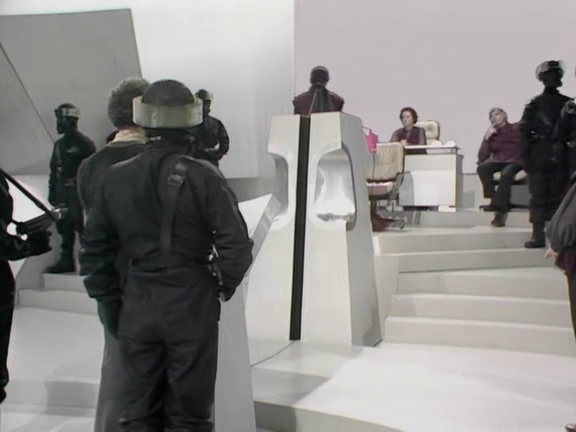
But my favorite part was the balance of the evidence, smack in the middle of the room. It’s a literal balance, y’all. Like the scales of justice.
Here’s how it works. Each side has their evidence.
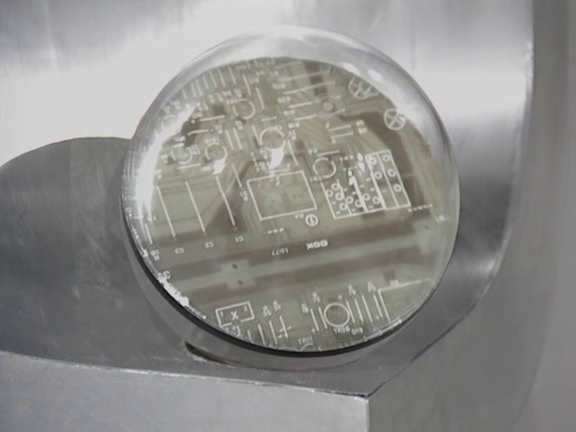
They each place their respective evidence onto the scale.
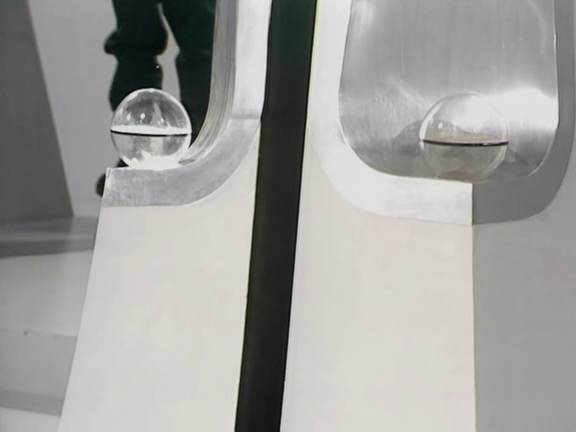
Then the evidence is weighed (and there’s a lovely light show to demonstrate to the viewer that the evidence is being considered).
Here’s the most prophetic bit—the evidence is weighed by . . . an artificial intelligence.
The judge’s only role is to read the verdict. And can ya believe it—the powers that be, who control the inputs and outputs of the artificial intelligence, curate both the evidence and the conclusion, and everyone simply accepts the truth of what is said!
Sounds fantastical, don’t it?
** ** **
It’s a major issue in civil litigation right now. Charlotin’s database, which tracks global court proceedings across 35 countries, has catalogued nearly 2,000 instances of AI hallucinations, with over half originating in the US.
Think the criminal justice system is immune? It ain’t. Just off the top of the ol’ dome:
- In 2016, the WI Supreme Court upheld the use of the COMPAS algorithmic risk assessment tool at sentencing, even though the tool’s internal methodology was proprietary and undisclosed to the defendant. COMPAS uses arrest data as a proxy for offending, but because arrest rates are higher in overpoliced Black communities, the tool inherits and perpetuates those racial disparities. Although race is not a direct input, socioeconomic factors correlated with race (e.g., neighborhood, employment history, prior arrests) serve as proxies that reproduce racial disparities. A ProPublica investigation found that COMPAS was almost twice as likely to incorrectly classify Black defendants as high-risk (45%) compared to white defendants (23%). COMPAS is used across multiple states.
- In 2020, Detroit police wrongfully arrested Robert Williams for felony larceny based on facial recognition technology that incorrectly identified him as the perpetrator. Even after the police department acknowledged the flaw, the police did not release him because they “lacked the authority” to do so. Between when Mr. Williams was arrested and Detroit settled with him, Detroit PD wrongfully arrested at least two other Black people relying on the same technology—technology DPD still uses.
- A study published in the Journal of Empirical Legal Studies this year examined the Virginia Pretrial Risk Assessment Instrument (VPRAI) and found evidence of racial bias. Because the tool is trained on data reflecting existing racial disparities in policing and arrest patterns, it reproduces those disparities in its recommendations. Researchers estimated that the VPRAI algorithm’s sensitivity (read: its ability to correctly identify those who will fail pretrial conditions) differs by defendant race, meaning the tool performs unequally across racial groups. The study estimated wrongful detention rates of 39.7% for white defendants and 51.4% for Black defendants—meaning Black defendants are more likely to be incorrectly detained pretrial.
But what about judicial discretion? Girl. Be for real. The VPRAI study authors noted that it’s not just the AI—judicial decisions also display evidence of bias aligned with the tool’s outputs. Research on cognitive biases shows that decision-makers tend to “ascribe greater power and authority to automated aids than to other sources of advice,” leading judges to over-rely on the tool’s risk scores rather than conducting independent analysis.
And the number of judges who have been held to account has been vanishingly small. For example, in 2025, two federal district court judges withdrew their rulings after a senate judiciary inquiry determined that they had issued erroneous rulings by taking their clerks’ AI-generated legal opinions at face-value. That’s it. Two.
Meanwhile, thanks to a 2026 survey of over 500 randomly selected federal judges, we know that over 60% used at least one AI tool in their chambers without any formal training. Because AI use does not need to be disclosed, litigants have no way of knowing whether AI was used in evaluating their cases or in drafting decisions. It’s a huge problem for a lot of reasons, not least because the “scientific” appearance of algorithmic outputs can actually make racial bias harder to challenge by cloaking the bias in a veneer of quantitative legitimacy.
Of course, it’s not just judges who are surrendering their human judgment to the algorithm—it’s a lot of people. I know it’s not everybody, but it sure feels like it. Every other conversation or social media post is
“I asked ChatGPT and it says—”
My brother in Christ, please, step away from the Zoltar.
“I asked Grok and it says—”
Fucking Grok? Really???
“I asked Claude and it says—”
Okay, well, I reached into the past using this incredible technology called a newspaper archive to obtain the contemporaneous mental impression of this dude named Daniel Boorstin and he said, “The greatest enemy of knowledge is not ignorance, but the illusion of knowledge.”
And did I take it at face value? No, because it's not enough for something to sound convincing. I thought about it. And skeptically examined whether the evidence supports the conclusion. Carl Sagan didn't raise no fool.
** ** **
Fun fact of the day, the word “verdict” is from the Old French ver (truth) + dict (proclaimed).
Maybe it’s just me, but proclaiming the truth seems like a weird thing to entrust to the people litchrully invested in using it to control us.